The ultimate guide to artificial vertical gardens: types, sizes, and maintenance
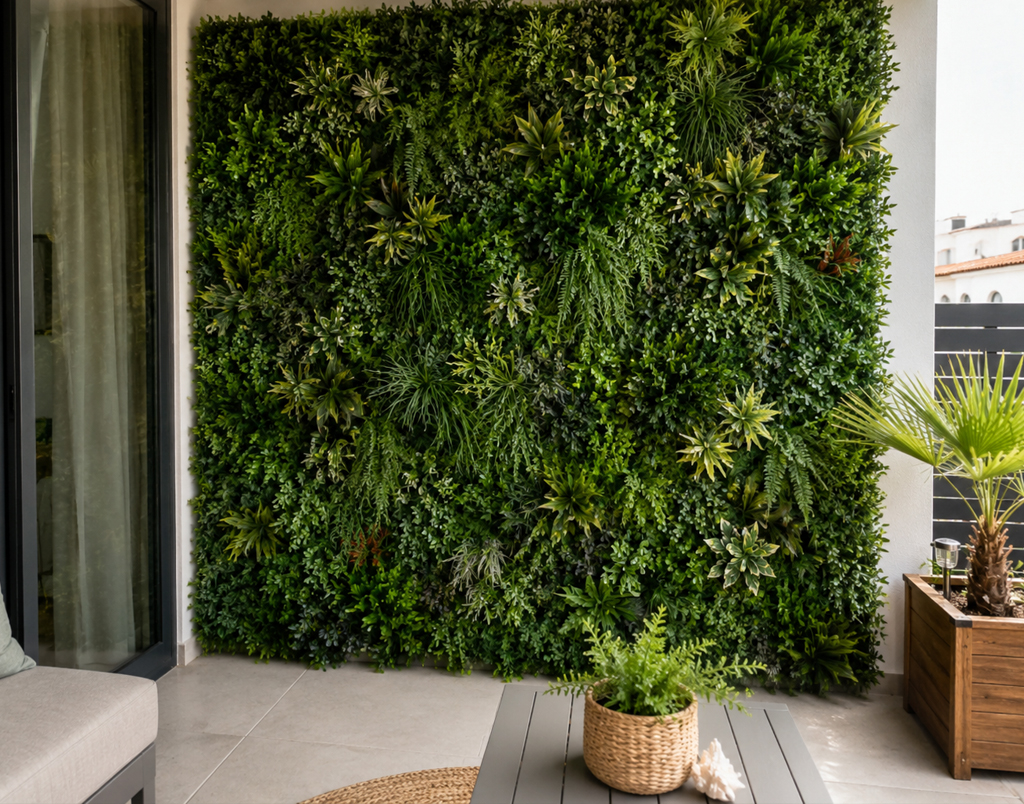
A well-chosen artificial vertical garden can completely transform a wall. When it is empty, the space often looks colder and lifeless. When the panel fits the surroundings, the overall look gains warmth, texture, and presence. That is when you really notice the difference.
It is increasingly used in homes, terraces, offices, and commercial premises because it meets a very specific need: adding visual freshness, texture, and a sense of life without the need for watering or ongoing care. It is a practical solution, yes, but not all models deliver the same result.
Before choosing, it is worth looking at more than just the design. The type of foliage, the panel size, density, materials, and outdoor resistance are the factors that most influence the final result. In this guide, I explain what to look for to make the right choice.
Estimated reading time: 7 minutes
Table of contents
What is an artificial vertical garden
An artificial vertical garden is a decorative composition made up of synthetic plants that is installed on walls, partitions, or vertical structures. Its main purpose is aesthetic, although it also helps soften spaces, cover unattractive surfaces, or add extra privacy.
It is best not to confuse it with other similar solutions.
A natural vertical garden, which needs watering and maintenance, is not the same as a preserved one, made with treated natural plants that also require care.
That is why it fits so well in spaces where you want an eye-catching result without complications.
Types of artificial vertical gardens
At this point, it is no longer just a matter of taste. The panel’s visual quality also comes into play.
Panels with uniform foliage
These are panels that repeat the same type of leaf across the entire surface. They work well when you are looking for a clean, tidy, and discreet finish. Even so, if the design is too repetitive, the result may look less natural, especially on large or highly visible walls.
Panels with a mix of leaves and textures
They usually offer a more natural and decorative result. The combination of shapes, sizes, and shades adds visual depth and makes the overall look more convincing, especially when the vertical garden will have a strong presence. For decorative interiors or visible areas, they are often a very rewarding option.
Panels with more volume
Models with more relief and density create a more immersive overall look. They work especially well on feature walls, in reception areas, on terraces, or in commercial spaces where a greater visual impact is desired.
Panels for indoor or outdoor use
This point is decisive. If the vertical garden is going to be installed outdoors, it is important to choose durable materials with UV protection. Sun and weathering have more impact than it seems, and an unprepared panel can lose colour over time.
Overall, a good artificial vertical garden stands out for the balance between density, foliage variety, volume, and the quality of the backing. When these elements are well resolved, the result looks much more natural.
What size artificial vertical garden to choose
Size should not be chosen based on measurements alone. The visual effect you want to create on the wall also matters.
Modular formats are especially practical because they make it easy to adapt the composition. At JardinArtificial.es, for example, you can find a wide range of formats such as 50×50, 50×100, 60×40, 100×100, and 100×200, making it easier to work on both small areas and large surfaces.
For small spaces
If you want to decorate a column, a corner, or a small section of wall, smaller formats are usually enough. They are easier to handle and allow you to fine-tune the finish without overwhelming the space.
Models such as Évora, Cádiz, or Ibiza in 50×50 artificial vertical garden panels work well when you want a decorative touch without too much prominence.
For large surfaces
When the goal is to cover an entire wall, larger panels are more convenient. They reduce the number of joins, speed up installation, and provide a more uniform look.
Options such as New Mallorca, Madrid, or Barcelona in 100×100 format work well on large walls where a more continuous, immersive look is desired.
And if the aim is to cover large surfaces quickly, options such as Celosía Verde or Celosía Salou in 100×200 make installation much easier.
For irregular walls and nooks
On walls with sockets, corners, or architectural elements, small or medium formats adapt better. They offer more flexibility for adjustments without complicating installation.
To achieve a more decorative effect
For those looking for a more aesthetic and less conventional solution, there are options with artificial vertical gardens in picture or frame format, such as Cuadro Madera 100×100 or Cuadro Marco Blanco 50×50. They are ideal for interiors where the artificial vertical garden acts almost like a design piece.
One of the great advantages of panel-based artificial vertical gardens is their adaptability. They allow you to expand the composition over time, combine different models, or adjust the design without having to redo the entire installation.
How to choose a quality artificial vertical garden
Before buying, it is worth focusing on three aspects: visual appearance, materials, and the backing system.
The first is visual appearance. A panel that is too flat or has very repetitive leaves usually looks more artificial, especially on large surfaces or in highly visible areas. By contrast, when there is a variety of tones, different types of leaves, and some depth, the final effect looks much more natural.
It is also important to look at the materials. For outdoor use, HDPE and other durable materials with UV protection are especially recommended, as they help preserve colour and structure for longer.
Finally, it is advisable to check the backing and mounting system. A sturdy, well-designed backing makes installation easier and improves the overall durability.
Artificial vertical garden maintenance
One of the great advantages of this decorative option is that it requires very little maintenance. It does not need watering, fertiliser, pruning, or specific treatments, although it is advisable to provide basic care to keep it looking its best.
To keep it in good condition, it is enough to remove dust periodically. This can be done with a duster, a damp cloth, or water with neutral soap, depending on the type of dirt and the panel’s location.
In addition, it is advisable to check the fixings from time to time and make sure all parts are still securely fastened, especially if it is installed outdoors. In many models, if a leaf comes loose, it can be easily put back in place.
Recommended basic care
- Remove dust periodically.
- Use gentle products and avoid harsh cleaners.
- Check fixings and anchors from time to time.
- Make sure the model has UV protection if it will be installed in direct sunlight.
Although maintenance is minimal, these small steps help preserve the appearance of the artificial vertical garden over time.
Artificial vertical garden for indoor and outdoor use
Artificial vertical gardens work very well in both indoor and outdoor spaces, but in each case it is worth considering a few aspects.
Indoors, they are often used to decorate living rooms, entrance halls, offices, commercial premises, or passageways. They add visual warmth and can become a very attractive focal point.
Outdoors, they are commonly seen on terraces, balconies, patios, and façades. In these spaces, they are especially useful for improving aesthetics, adding privacy, or covering less decorative walls. However, to keep them looking good, it is essential to choose a model designed to withstand exposure to sun and weather.
Choosing an artificial vertical garden is not only an aesthetic matter. It is also important that it fits the space, has a well-proportioned size, and is made with materials capable of maintaining a good appearance over time.
When chosen well, the result blends naturally into the environment, adds visual warmth, and requires hardly any maintenance. That is, ultimately, one of its great advantages.