


How to calculate how much artificial turf you need without buying extra
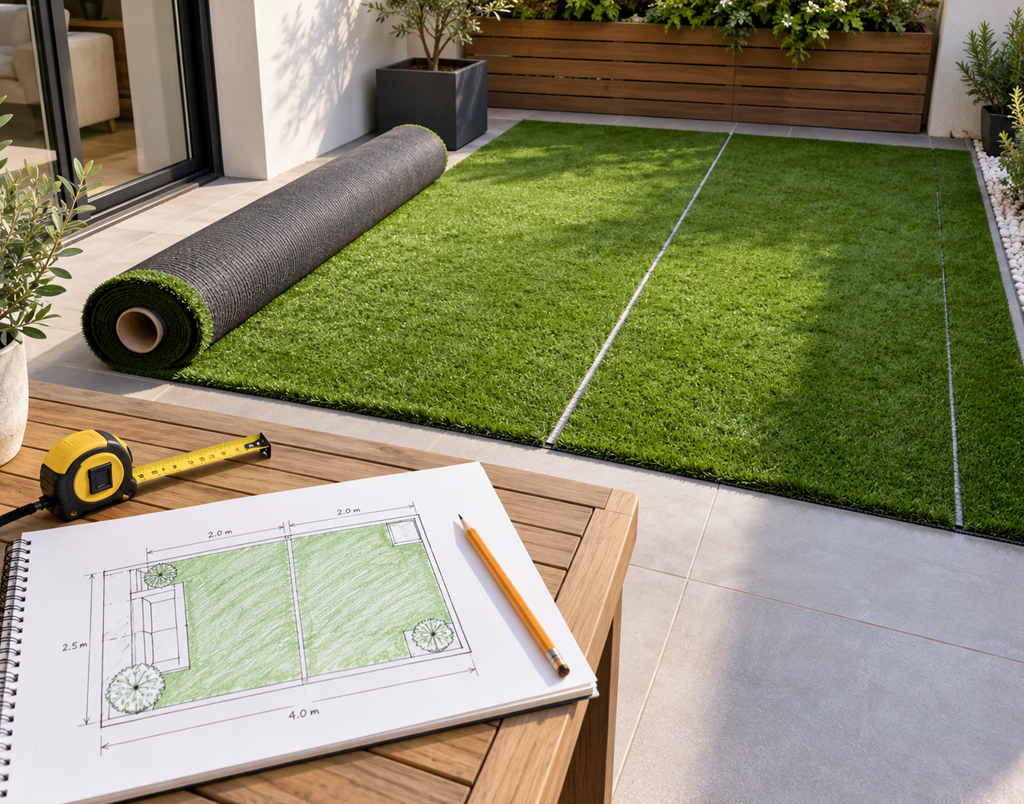
Measuring properly saves you turf, cuts, and the occasional headache.
Calculating the square metres of artificial turf seems simple: length times width and you are done. The maths does not fail, but… turf is supplied in rolls, and that changes the calculation quite a bit.
At Jardin Artificial we work with rolls 2 metres wide, so knowing the total area is only the starting point. To order the right amount, you also need to think about how you will lay out the sections.
Start by making a sketch
There is no need to get out a set square and triangle, or discover a late vocation as an architect. A simple drawing will do.
Measure the length and width of the space and write down all the measurements. If there are columns, planters, steps, trees, or irregular areas, mark those too.
On a rectangular surface 5 metres long by 4 wide, you have 20 m². Here the numbers work out neatly: two 2 × 5 metre sections cover the entire space.
But you will not always be that lucky.
Calculate the sections, not just the area
Now imagine a terrace measuring 5.20 × 3.60 metres. Its area is 18.72 m², but ordering exactly that amount would not allow you to cover it properly.
If you lay the sections along the 5.20-metre length, you will need two pieces of 2 × 5.20 metres. In total, 20.80 m² of artificial turf.
What if you change the orientation? To cover the 5.20 metres you would need three sections 2 metres wide and 3.60 metres long: 21.60 m².
Same terrace. Different layout. Almost a square metre of difference.
Before buying any of our artificial turf models, draw 2-metre bands on your sketch and try different layouts. That way you will see which one makes the best use of each roll and where the seams will be.
In irregular spaces, divide and conquer
An L-shaped terrace or a garden with columns cannot be measured as neatly as a single rectangle.
Divide the space into simpler areas, calculate each one separately, and check whether the offcuts from one section can be used to complete another part. That small puzzle helps you make better use of the material.
There is another detail you should not overlook: all sections must keep the same fibre direction. Turning a leftover piece to make better use of it may be tempting, but once installed, the change in orientation will show.
That is also why I do not like the automatic rule of “buy 10% more”. In some projects it will be too much; in others, not enough. The right amount depends on the shape of the space and how the sections fit together.
What if your terrace looks like a geometry problem?
Some patios make the calculation much harder: pools in the middle, corners, planters, recesses, or several connected areas.
If you are not sure about the layout, you can send us a sketch with the measurements and we will help you calculate the metres and the layout of the sections before you place the order.
Once you have the quantity sorted, it is time to prepare for installation. In our guide to what you need to install artificial turf, we go over the materials and accessories required.
The next step will depend on the surface you have: preparation changes if you are going to install artificial turf over paving or if you need to lay it over soil.
Because measuring twice is still far cheaper than buying twice.
