Complete guide to choosing artificial turf based on use
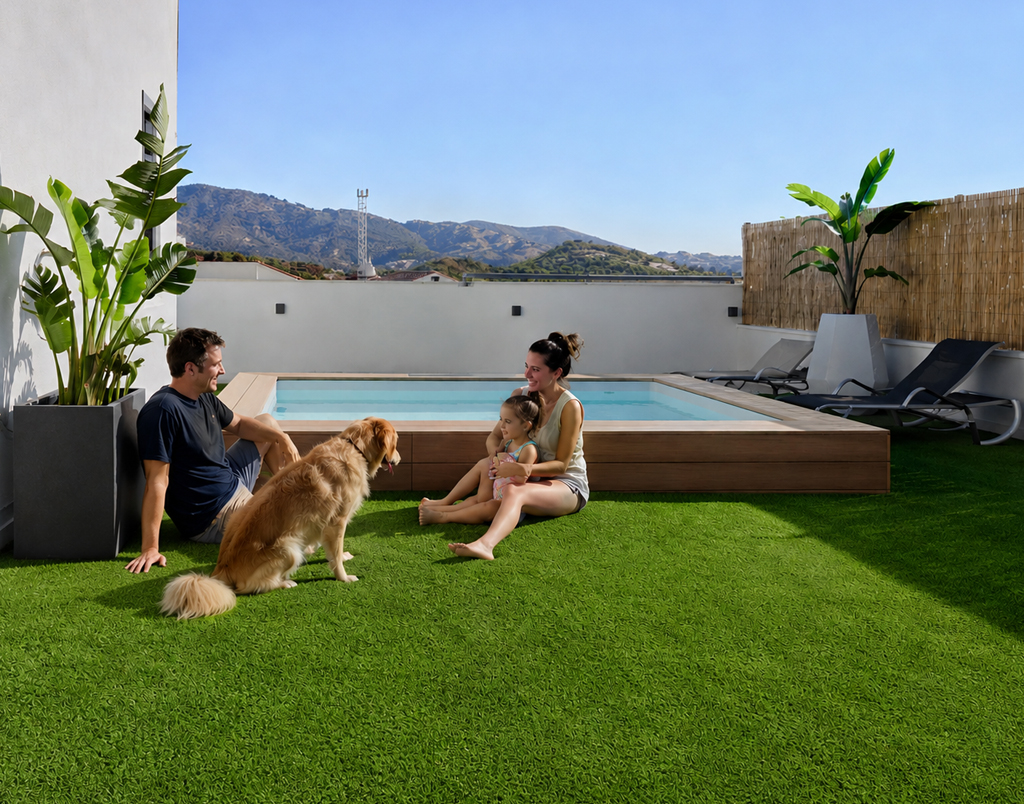
Choosing artificial turf goes far beyond deciding on a color or imagining how it will look in your garden: it requires thinking about what use you are going to give it, who is going to walk on it, and how you want it to look over time.
This guide will help you choose wisely between 30, 35, and 40 mm models, so that the result is beautiful, functional, and durable without complications.
Estimated reading time: 4 minutes
Table of contents
Height and density: why are they so important when choosing?
Before looking at specific use cases, there are two key concepts you should keep in mind:
Height
Fiber height (indicated in mm) influences:
- The underfoot feel (softer or firmer).
- The visual appearance (more natural or more uniform).
30 mm tends to be more functional, 35 mm is balanced, and 40 mm is more decorative.
Density
This is what truly makes the turf withstand daily use: the higher the density, the easier it will be for the fibers to recover their position after being stepped on and the less they will flatten over time.
In short, more height does not always mean better — if it is accompanied by low density, the turf may look “fluffy” but will wear out quickly.
Recommended models based on use
There are different models of artificial grass, depending on the space and the needs you want to cover. Here we explain what to choose depending on where you are going to install it:
Terraces and balconies (moderate use)
These spaces usually have furniture, plants, and frequent but not “intense” traffic.
Perfect models:
- Economy 30 mm Artificial Turf: practical and resistant, ideal for small spaces.
- Barcelona Pro 30 mm Artificial Turf: a good option if you want a slightly more elegant finish without increasing the height.
- Madrid Regreen 32 mm Artificial Turf: a middle ground if you are looking for a slightly softer touch without losing functionality, and it is also recyclable.
Why we recommend them: the moderate height makes it easy to clean and maintain, and it pairs well with tables, chairs, and pots without looking “overcrowded.”
Family gardens (general use)
These usually involve children playing, gatherings, and varied traffic, so you want something comfortable yet resistant.
Recommended models:
- Economy 35 mm Artificial Turf: versatile and easy to maintain.
- Valencia 35 mm Artificial Turf: an excellent option if you care about both the feel and the natural look.
- España 35 mm Artificial Turf: one of the most balanced options if you are torn between comfort and durability.
Why: these heights offer a more “natural” and welcoming feel without sacrificing resistance to daily use.
Poolside areas (barefoot walking + humidity)
In areas with water, it is advisable to choose turf that:
- Drains well.
- Is pleasant to the touch when barefoot.
- Withstands repeated footsteps after swimming.
Suitable models:
- Valencia 35 mm Artificial Turf: a good balance between softness and drainage.
- Economy 30 mm Artificial Turf: very functional if you prioritize quick cleaning.
- Cádiz 40 mm Artificial Turf: if your intention is for it to be more decorative and it will be used less than if there were children or pets.
Tip: avoid excessive heights if the priority is for it to dry quickly and be cleaned effortlessly.
Pets (intense use + dirt)
When there are dogs or cats, you need resistance, drainage, and easy cleaning.
Top models for pets:
- Economy 30 mm Artificial Turf: low and resistant, easy to brush and clean.
- Barcelona Pro 30 mm Artificial Turf: with a comfortable feel but without sacrificing durability.
Avoid heights greater than 35 mm if your priority is to keep the turf impeccable with less cleaning effort.
Common mistakes when choosing artificial turf
- Choosing based only on the photo without looking at the actual height and density.
- Thinking that the tallest is the best in all cases.
- Not taking into account the actual daily use it will have.
- Ignoring the type of fiber and how it drains water.
A good trick is to imagine how and who is going to use that turf every day; that will help you decide on the best model for each case.
Quick visual comparison of heights
30 mm height:
- Underfoot feel: Firm and functional
- Recommended use: Terraces, pets, high-traffic areas
35 mm height:
- Underfoot feel: Balanced and comfortable
- Recommended use: Family gardens, mixed areas
40 mm height:
- Underfoot feel: Very natural and decorative
- Recommended use: Large gardens, decoration, moderate traffic
How to get it right from the start
If your goal is to install the artificial grass yourself, start by defining what you are going to use that space for and the type of daily use it will have. At jardinartificial.es, you will find a wide range of 30, 35 and 40 mm models with detailed product sheets, measurements, and the option to buy it in rolls or cut to size to fit your area.
Final recommendation: do not be swayed only by the aesthetics in the photos; evaluate height, density, and intended use and you will surely get it right.